
The Chaos Is the Job
The Chaos Is the Job
There’s a moment every leader in policing knows well.
You’ve finally gotten your arms around one issue. Your team has adapted. You’ve updated the training, revised the policy, had the conversation you needed to have. And then, almost on cue, something new lands on your desk. A new directive from city hall. A public incident that changes everything. A political environment that has your community looking to you for answers you don’t have yet.
And somewhere in the back of your mind, a voice says: when does this slow down?
Here’s the honest answer. It doesn’t. And the sooner we make peace with that, the better leaders we become.
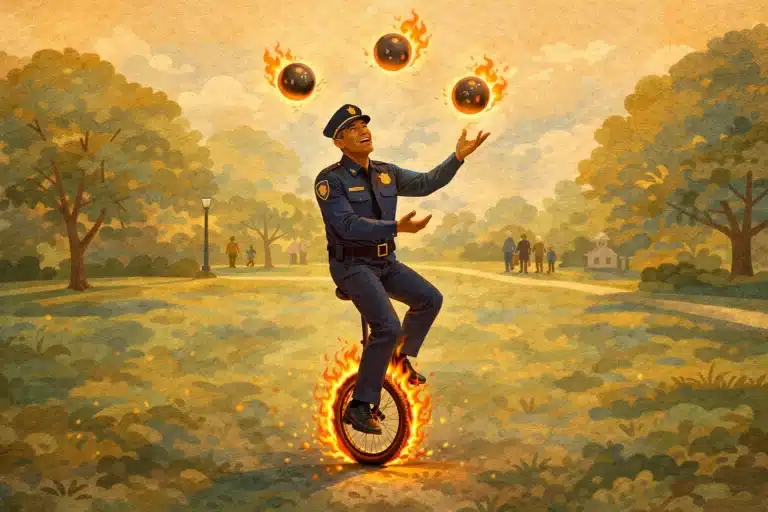
Chaos isn’t the exception. It’s the terrain.
I sat down recently with Simon Sinek to talk about leadership with a room full of public servants. One of the first questions I asked him was how leaders in government can inspire their people when the environment is always shifting under their feet.
His answer surprised some people in the room. He said he actually likes a little chaos. Not because chaos is comfortable, but because chaos is where creativity lives.
Think about that for a moment. Every time something doesn’t go according to plan, there is space for someone on your team to solve a problem in a way no policy manual ever anticipated. That’s not a threat. That’s an opportunity.
But here’s the catch. Creativity without boundaries isn’t a gift. It’s a liability.
We’ve all seen what happens when someone on a team “solves” a problem outside the values of the organization. They did what they thought they were supposed to do. They found a way. And now you’re in damage control, explaining how that solution was never what you meant.
Values are the edges of the sandbox.
Strong culture doesn’t restrict creativity. It channels it. When your people know your values, when those values are lived and not just laminated on a break room wall, they know where the edges are. They can be creative, adaptive, and decisive inside that space and they know instinctively when something is outside the lines.
This is why culture is not a luxury for leaders in policing. It is a survival tool. Not just for the organization, but for the people we serve.
In policing, decisions happen fast. Officers, deputies and supervisors make judgment calls in seconds that will be reviewed in slow motion for months. If the only thing guiding those decisions is a policy manual, you will always be behind. Policy tells people what the minimum standard is. Culture tells people who you are.
When the environment is chaotic, people don’t reach for the policy. They reach for what they believe. Make sure you’ve given them something worth reaching for.
No one is smart enough to do this alone.
There’s one more thing Simon said that I think every leader in this profession needs to hear.
None of us is equipped to handle every challenge by ourselves. The problems we face in modern policing, from public trust to mental health crises to generational tension within our agencies, don’t have clean answers. They rarely fit neatly into the playbooks we were handed when we promoted.
The leaders who struggle most in chaotic environments are the ones who believe they’re supposed to have all the answers. They believe that confidence means certainty, and that asking for help is a sign of weakness.
It’s the opposite.
A group of people with common cause, sitting around a table and saying “I don’t know, how do we figure this out together,” will always outperform the smartest person in the room acting alone. Always.
The military has a saying: no plan survives contact with the enemy. Experienced leaders don’t fight that truth. They build teams and cultures that are ready to adapt when the plan falls apart, because they know it will.
What this means for you.
If you’re an aspiring leader in policing, here’s what I want you to take from this.
Stop waiting for things to stabilize before you start leading. The stability isn’t coming. The job is the chaos. Your role is to hold your values steady while everything else moves.
Build your team so they understand the why behind every decision, not just the what. Give them the context they need to be creative within the right boundaries. And then trust them. Trust that when the next unexpected thing lands, they’ll know how to respond because they know who you are as a department, and they know who they are.
And when you don’t have the answer, say so. Pull your people in. Ask the question out loud. You will be amazed what happens when a leader is honest enough to say, “I need help with this,” and brave enough to mean it.
That’s not weakness. That’s how the best organizations in the world operate.
The chaos is not in your way. It is the job. And if you can lead through it with values, with humility, and with people around you who trust each other, you’ll find that the hardest moments are often the ones that reveal what your culture is truly made of.
That’s worth building for.
Chris Hsiung